- Workplace Statistics
- Time Management Statistics
- Employee Wellness Statistics
- Employment Discrimination Statistics
- Employee Recognition Statistics
- Employee Referral Statistics
- Workplace Violence Statistics
- Gamification Statistics
- Employee Feedback Statistics
- Agile Statistics
- Productivity Statistics
- Meeting Statistics
- Cell Phones At Work Statistics
- Social Media At Work Statistics
- Workplace Injury Statistics
- Workplace Stress Statistics
- Leadership Statistics
- Workplace Collaboration Statistics
- Job Satisfaction Statistics
- Paid Holiday Statistics
- Communication In The Workplace Statistics
- Wasting Time At Work Statistics
- 4-day Workweek Statistics
Research Summary. As we move into 2026, employee wellness programs continue to gain traction, offering significant advantages for both employees and employers. Here are the crucial insights from our research on employee well-being:
-
52% of U.S. companies currently have wellness programs in place.
-
72% of employers reported decreased healthcare costs following the implementation of wellness initiatives.
-
The average return on investment (ROI) for these programs is six-to-one.
-
Wellness programs can reduce absenteeism by 14-19%.
-
87% of employees take health and wellness offerings into account when selecting an employer.
For a more detailed analysis, we categorized the data in the following sections:
Frequency of Wellness Programs | Employer Benefits | Company Size | Worker Opinions
Employee Wellness Statistics By Employee Benefits
-
56% of employees participating in company wellness programs report having fewer sick days.
These employees also indicate a 60% increase in productivity when present at work. Additionally, 30% have had health issues identified through these programs, enabling early intervention.
-
Over 80% of employees whose employers actively engage in wellness initiatives express enjoyment in their work.
Moreover, around 85% plan to remain with their current employer. Conversely, only about 40% of employees without employer engagement in wellness report job satisfaction, with 58% considering leaving their jobs.
-
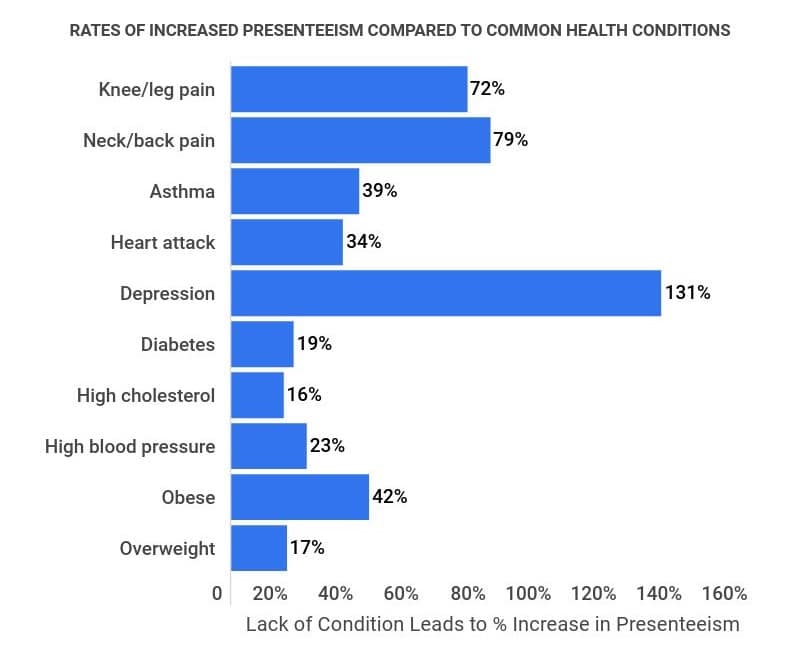
Employees who do not engage in regular physical activity are 50% more likely to experience presenteeism compared to regular exercisers.
Presenteeism occurs when employees are physically present but not fully productive. Regular exercise minimizes this issue, enhancing both productivity and overall company performance.
-
In one study, 57% of employees with elevated health risks transitioned to low-risk status after participating in employer-sponsored exercise programs.
These programs, which included cardiac rehabilitation, were facilitated by professionals and took place at the workplace, removing major participation barriers.
Employee Wellness Statistics By Frequency of Wellness Programs
-
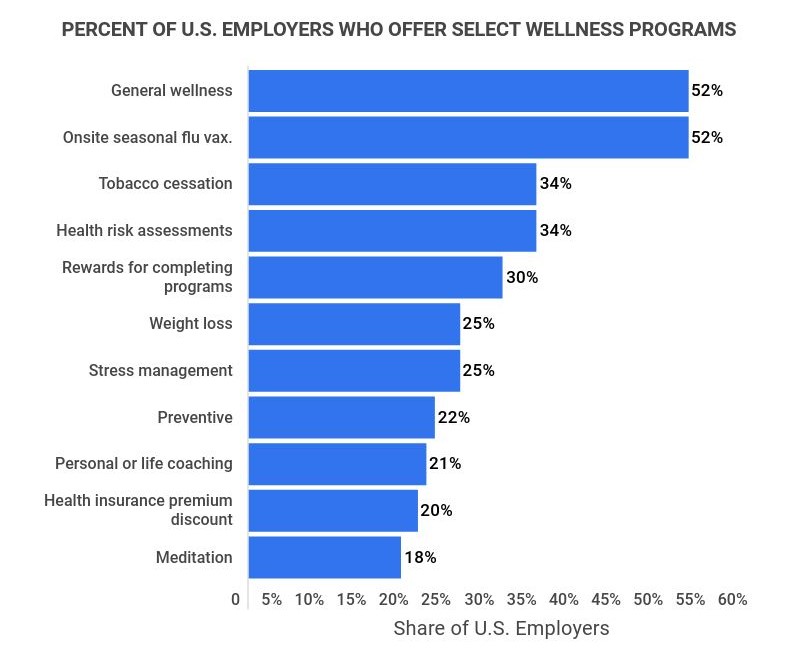
52% of U.S. companies offer a wellness program.
Additionally, 30% provide rewards or bonuses for completing health and wellness initiatives, while 20% offer health insurance premium reductions for participation.
-
51% of employers currently offer health screenings as of 2023.
This figure reflects a decline from previous years, down from 59% in 2017. Additionally, 44% provide health education, and 39% supply links to health and wellness-related employee services.
-
37% of employers have integrated health promotion into their company culture.
This marks a decrease from previous years, where 46% reported the same in 2016 and 2017.
Employee Wellness Statistics By Employer Benefits
-
Companies that implement wellness programs generally experience a six-to-one return on investment (ROI).
This ROI stems primarily from lower healthcare costs and reduced absenteeism, which helps offset the investment in these programs.
-
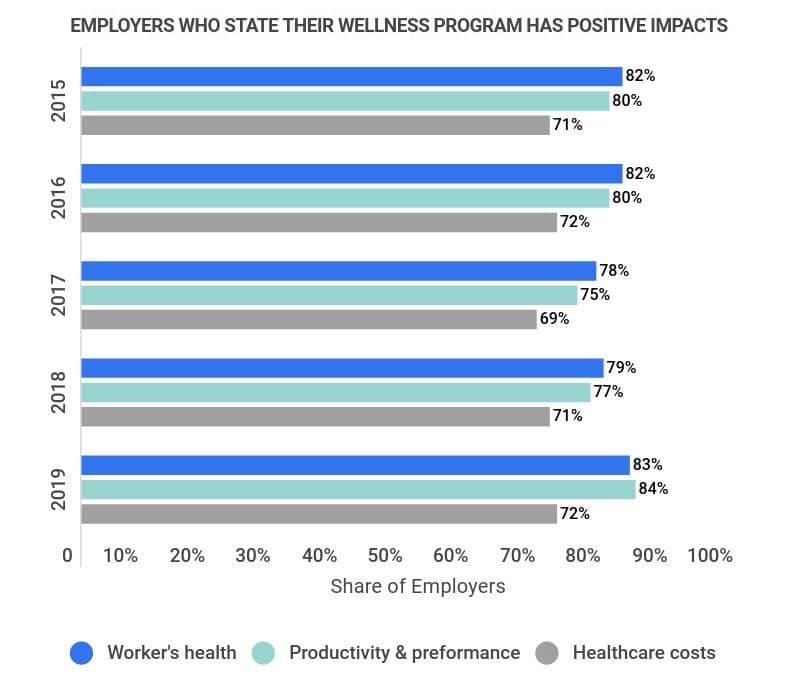
84% of employers indicate improved productivity and performance among their employees due to wellness initiatives.
This figure is an increase from 77% in 2018 and 75% in 2017. The expectation of wellness programs is now a standard consideration for top talent when evaluating job postings.
-
83% of employers recognized enhanced employee health as a result of their wellness programs.
This shows a positive trend from 78% in 2017, reflecting the growing impact of wellness initiatives.
-
72% of employers report lower healthcare costs associated with wellness program implementation.
This is an increase from 69% in 2017, indicating a steady upward trend in financial benefits for companies investing in wellness.
-
Wellness programs can potentially decrease absenteeism by 14-19%.
Some organizations have reported even greater decreases; for example, General Electric saw a 45% reduction in absenteeism thanks to their wellness initiatives.
Employee Wellness Statistics By Company Size
-
83% of large companies offer wellness programs.
Here, “large companies” refers to organizations with 200 or more employees.
-
58% of small companies provide wellness initiatives.
In this context, a “small company” is defined as having 3-199 employees.
-
Companies with 5,000 or more employees are the most likely to have wellness programs.
94% of these companies offer such programs, followed closely by 92% of organizations with 1,000 to 4,999 employees.
-
Companies with fewer than 50 employees are the least likely to offer these programs.
57% of these organizations provide wellness initiatives, which is still a significant percentage given their size. Companies with 50-199 employees follow closely behind, with 70% offering wellness programs.
Employee Wellness Statistics By Worker Opinions
-
38% of HR leaders believe their organizations effectively support employees’ physical wellbeing.
-
17% of employees feel supported by their employers in managing their physical health.
-
60% of CEOs believe their companies demonstrate empathy towards their employees.
-
24% of employees perceive their employers as empathetic.
-
74% of employees would be willing to work longer hours if their employer exhibited empathy.
| Country | Employees feel meaningfully recognized by their employer at least monthly | Employees feel physically healthy | Employees feel supported at work in managing their physical well-being | Employees feel a sense of mental well-being | Employees feel supported at work in managing their mental well-being | Employees feel at least somewhat stressed | Employees have taken stress leave |
|---|---|---|---|---|---|---|---|
| Australia | 45% | 19% | 21% | 20% | 21% | 49% | 31% |
| Canada | 33% | 19% | 15% | 17% | 16% | 43% | 19% |
| U.K. | 42% | 21% | 17% | 21% | 19% | 49% | 26% |
| U.S. | 37% | 20% | 15% | 18% | 15% | 34% | 31% |
Employee Wellness Statistics FAQ
-
How many companies have wellness programs?
52% of companies have wellness programs. While there are no definitive statistics on the exact number of companies offering these programs, around 63 million workers benefit from wellness initiatives, with 59 million employed by larger companies.
-
What are workplace wellness programs?
Workplace wellness programs are employer-driven initiatives designed to enhance employee health. These programs may aim to motivate employees to prioritize their wellness, enhance accessibility to healthcare, or support individuals in their health journeys.
Many organizations offering such programs incorporate various elements, from cash incentives for achieving health-related goals to hosting vaccination drives and providing access to fitness classes and healthy food options. The benefits of these programs extend to both employees and employers, as healthier, happier employees tend to be more engaged and productive, positively impacting the company’s bottom line.
-
Why is wellness important in the workplace?
Wellness is vital in the workplace because healthy employees are generally happier and more productive. Without proper self-care, even the most dedicated employees can experience burnout or health issues, so encouraging wellness is essential for maintaining a productive workforce.
Moreover, employees typically boost their performance and engagement when they feel cared for, which enhances overall job satisfaction. Many workers credit early health interventions, weight loss, and improved fitness to their employers’ wellness initiatives. Notably, 80% of employees working for companies with strong wellness programs report enjoying their jobs.
Thus, promoting wellness benefits both employers and employees alike.
-
How can companies improve wellness in the workplace?
Companies can enhance workplace wellness by prioritizing it and offering relevant resources and services. This requires actively listening to employees to ensure that wellness initiatives meet their needs and aspirations.
Ultimately, improving workplace wellness necessitates embedding it into the corporate culture, as even the best programs will fall short if employees do not appreciate their importance or feel encouraged to engage with them.
-
What are some examples of workplace health programs?
Examples of workplace health programs include cash incentives for maintaining a fitness regimen, discounts on gym memberships or access to onsite gyms, and provision of flu vaccinations and health screenings.
Additionally, initiatives like stocking vending machines with healthy snacks, allowing flexible hours for workouts, or connecting employees with health professionals to manage chronic conditions are also common practices. Many companies create multifaceted health programs to cater to diverse employee needs, whether they are fitness enthusiasts or just beginning their wellness journey.
Conclusion
As of 2026, employee wellness programs are increasingly prevalent, with 52% of U.S. companies offering such initiatives. These programs yield substantial benefits for employees, with 56% reporting fewer sick days and 80% expressing job satisfaction.
Employers also reap significant rewards from wellness programs: 72% report decreased healthcare costs, while 84% observe improved productivity and performance.
With an average ROI of six-to-one, companies earn $6 for every $1 invested, primarily due to reduced medical expenses and lower absenteeism linked to wellness initiatives.
References
-
EBN. “Wellness Programs Cut Sick Days, Improve Productivity.” Accessed in March 2026.
-
WellSteps. “The 7 Best Reasons to Have a Wellness Program: Benefits of Wellness.” Accessed in March 2026.
-
Harvard Business Review. “What’s the Hard Return on Employee Wellness Programs?” Accessed in March 2026.
-
Statista. “Percentage of Employers in the U.S. That Offered Select Wellness Programs and Events as of 2020.” Accessed in March 2026.
-
Statista. “Percentage of Employers Who Stated That Select Elements Were Offered in Their Company’s Wellness Programs in the U.S. From 2015 to 2018.” Accessed in March 2026.
-
Bravo. “Do Wellness Programs Save Companies Money?” Accessed in March 2026.
-
Statista. “Percentage of Employers in the U.S. Who Stated Their Company’s Wellness Program Had Positive Impacts From 2015 to 2019.” Accessed in March 2026.
-
Corporate Wellness Magazine. “Employee Wellness Programs for a More Productive Workforce.” Accessed in March 2026.
-
Statista. “Percentage of U.S. Firms Offering Select Health-Related Programs as of 2021, by Firm Size.” Accessed in March 2026.
-
SHRM. “Report: Employees Say Support for Their Well-Being Falls Short.” Accessed in March 2026.
-
Andrea M. Delligatti, Ph.D. “The Gordian Knot for Employers in 2022: How To Untangle It Through Empathetic Leadership.” Accessed in March 2026.
- Workplace Statistics
- Time Management Statistics
- Employee Wellness Statistics
- Employment Discrimination Statistics
- Employee Recognition Statistics
- Employee Referral Statistics
- Workplace Violence Statistics
- Gamification Statistics
- Employee Feedback Statistics
- Agile Statistics
- Productivity Statistics
- Meeting Statistics
- Cell Phones At Work Statistics
- Social Media At Work Statistics
- Workplace Injury Statistics
- Workplace Stress Statistics
- Leadership Statistics
- Workplace Collaboration Statistics
- Job Satisfaction Statistics
- Paid Holiday Statistics
- Communication In The Workplace Statistics
- Wasting Time At Work Statistics
- 4-day Workweek Statistics

Author

Abby is a writer who is passionate about the power of story. Whether it’s communicating complicated topics in a clear way or helping readers connect with another person or place from the comfort of their couch. Abby attended Oral Roberts University in Tulsa, Oklahoma, where she earned a degree in writing with concentrations in journalism and business.